
3 Ways Robotic Process Automation Boosts Mortgage and Title BPO Efficiency
The mortgage and title industry runs on precision, documentation, compliance, and speed. Yet, much of the daily workload still involves repetitive tasks such as data entry, document validation, compliance checks, and system updates. When handled manually, these processes increase the risk of delays, rework, and costly human errors.
This is where robotic process automation steps in as a game changer. By automating rule-based and repetitive workflows, RPA helps mortgage lenders, servicers, and title companies operate faster, more accurately, and at lower cost. For BPO providers supporting this ecosystem, RPA is no longer optional; it is a competitive advantage.
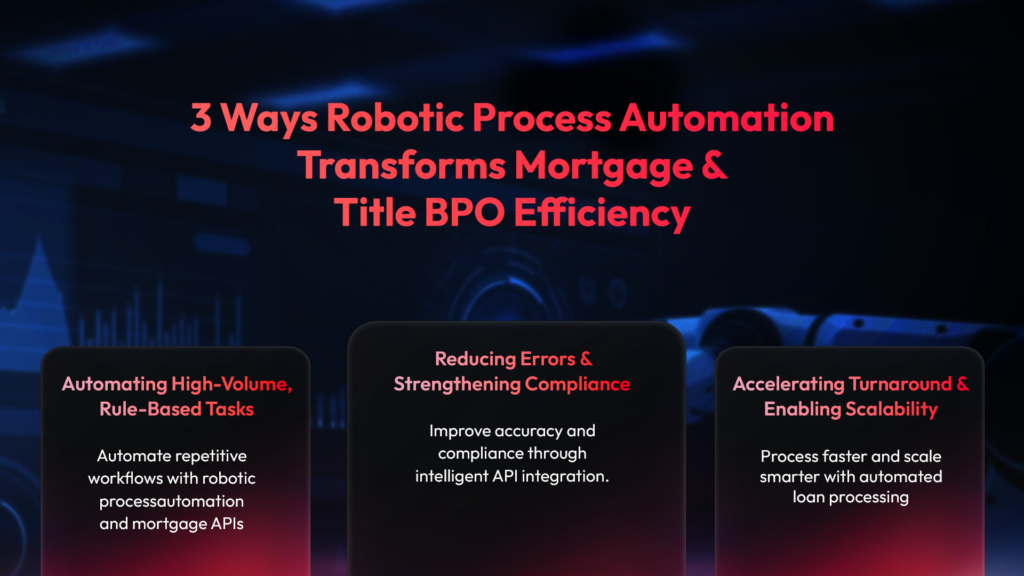
Below are three powerful ways robotic process automation transforms mortgage and title BPO efficiency.
1. Automating High-Volume, Rule-Based Tasks
Mortgage and title operations involve countless structured tasks such as:
- Extracting borrower information from applications
- Validating documents against checklists
- Updating LOS and CRM systems
- Ordering title searches and appraisals
- Performing compliance cross-checks
These tasks follow predefined rules and standardized workflows, making them ideal candidates for robotic process automation.
RPA bots can log into multiple systems, capture data, compare it against preset criteria, and flag discrepancies within seconds. Unlike manual processing, bots do not experience fatigue or oversight, significantly reducing errors.
When paired with API integration services, RPA becomes even more powerful. Through seamless connections with mortgage APIs and external data sources, bots can pull credit scores, employment verification data, or property records automatically. This ensures that information flows smoothly across platforms without requiring human intervention.
For organizations leveraging an API for loan processing, automation eliminates redundant data entry and ensures real-time updates across systems. The result is faster turnarounds and fewer bottlenecks in underwriting and title clearance workflows.
At Invisia BPO, we design automation frameworks that integrate directly into client ecosystems, ensuring that robotic process automation enhances, rather than disrupts, existing operations.
2. Reducing Human Error and Compliance Risk
Mortgage and title transactions are heavily regulated. A small data inconsistency, missing document, or miscalculated figure can trigger delays, audits, or financial penalties.
Manual workflows increase the risk of:
- Incorrect data transcription
- Missed compliance checkpoints
- Inconsistent file documentation
- Delayed status updates
Robotic process automation addresses this challenge by executing tasks consistently, based strictly on programmed logic. Bots follow the same rules every time, ensuring standardized compliance checks across thousands of files.
When integrated through advanced API integration services, RPA systems can automatically validate borrower data against compliance databases and regulatory frameworks. This highlights key API integration benefits, including improved audit trails, automated logging, and transparent workflow tracking.
Additionally, using mortgage APIs allows automated validation of third-party data such as income verification or tax records. These integrations significantly reduce the margin for manual oversight.
Invisia BPO combines domain expertise with intelligent automation to create compliance-focused RPA solutions. Our teams understand both regulatory nuances and technical execution, ensuring clients achieve efficiency without compromising accuracy.
3. Accelerating Turnaround Time and Scalability
Speed matters in mortgage and title operations. Borrowers expect quick approvals, and lenders aim to close deals faster to remain competitive.
Robotic process automation dramatically reduces turnaround times by:
- Processing files 24/7 without downtime
- Executing parallel workflows across multiple cases
- Triggering automated notifications and status updates
- Seamlessly integrating with an API for loan processing
With proper API integration services, RPA enables systems to communicate in real time. This means fewer email follow-ups, fewer manual status updates, and faster file movement between departments.
One of the strongest API integration benefits is scalability. During peak market cycles, file volumes surge. Hiring and training additional staff can be time-consuming and costly. RPA allows mortgage and title BPO providers to scale instantly without compromising quality.
At Invisia BPO, we build scalable automation architectures that adapt to fluctuating market demand. By combining robotic process automation with secure API integrations, we help lenders and title companies handle high volumes efficiently while maintaining service quality.
Final Thoughts
The future of mortgage and title operations is digital, integrated, and automated. Robotic process automation is not just about reducing manual work. It is about building smarter workflows that combine speed, accuracy, and compliance.
By leveraging robust API integration services, advanced mortgage APIs, and a well-structured API for loan processing, organizations can unlock substantial API integration benefits while transforming operational performance.
Invisia BPO stands at the forefront of this transformation. With deep industry knowledge and automation-driven solutions, we help mortgage lenders and title companies streamline workflows, reduce risk, and scale with confidence.